Iceni Technology Blog

All about PDF Editors, PDF Editing and
Office Productivity


Underline Bar
  1. 18Jun 2013

    How to Use Infix on Multiple PCs Without Reinstalling

    Often, users want to use their copy of Infix on more than one computer. They might want to use it at work, at home, on a friend’s computer or in the library.

    Although we have no commercial connection to Cameyo, we recommend it often. It’s like a Dropbox for apps: a way to move software from place to place, using the cloud for added convenience.

    Much like you’d move an mp3 on a memory stick, Cameyo moves applications. It does away with the need to keep reinstalling the software, so it effectively makes it completely portable.
    (more…)


  2. Underline Bar
  3. 10Jun 2013

    Exotic PDF editing and translation – out of the box!

    I’d like to give feedback on how Infix PDF editing saves us as a charity (University of the Nations) a lot of time.  
    Because of many people going through our study courses and internships, we have a lot of written research material on our file servers. Most of them are in editable and PDF file formats. But some of them, the important ones of course, we only have as PDF because the author left us already.
     
    Because of our multi-language setting in our study courses, we need some of these documents to be translated in different languages. And now is the time for Infix pdf editing.
     
    We tried several PDF editors (real and “so called”) and only Infix convinced us to be the tool we need. The demo version does all we need (beside the watermark, but that’s OK so far).
     
    Text editing even with exotic fonts works out of the box (no other program was so easy for this). Image relocation works and so on. And the best of it: it doesn’t need long time to get familiar with it!!
     
    We are very excited about this program. It saved days for us.
     
    - Danilo Ludwig


  4. Underline Bar
  5. 05Jun 2013

    How to Use Thumbnail View in Infix PDF Editor

    Version 6 of Infix PDF Editor includes a new view that makes working with pages easier and quicker. It’s called the Thumbnail Pane, and it’s ideal for working with long documents that span multiple pages.

    Opening the Thumbnail Pane in Infix v6

    To open the Thumbnail Pane view, click View -> Thumbnails from the Infix menu, or press the F8 key on your keyboard.

    The document view changes to show your document pages on the left and a closer view of the selected page on the right.

    Right-click within the left hand pane to bring up the Thumbnail Pane options menu. You can also reveal this menu using the small drop-down arrow at the top of the pane.
    (more…)


  6. Underline Bar
  7. 04Jun 2013

    Infix PDF Editor v6 Available to Download


    British software company Iceni has launched a new version of its acclaimed PDF editing application, Infix.


    PDF is a popular format for the distribution of documents via email and over the internet. However, PDFs are not editable in most free applications. Users must download PDF editing software to make changes, and this software must be paid for. Infix is one of the most affordable options for PDF editing on the market today.


    The Infix PDF Editor application has been reviewed and ranked 4.6 out of 5 on independent download site Download.com. It is available for Mac and PC, priced from free to £99 per licence.


    The new version 6 includes a number of new features for advanced PDF file editing:


    Advanced optical character recognition (OCR)
    Infix PDF Editor scans a paper document and turns it into an editable and searchable PDF file. Users can scan in a PDF, correct or edit the text, then re-save and distribute as normal.


    Thumbnail view for document overview
    Users can see thumbnail versions of the pages in their document in Infix PDF Editor. Using this overview, pages can easily be moved and deleted.


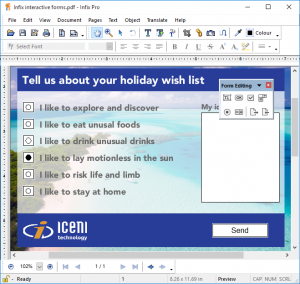
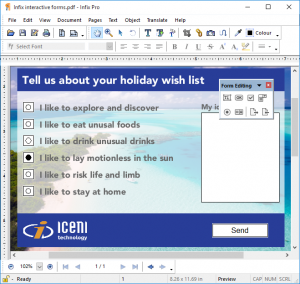
    Support for interactive forms and paper forms
    Infix PDF Editor has always supported the scanning and filling in of paper forms. Its features have been upgraded to also support interactive forms (forms that display interactive elements on-screen).


    Key Facts

    ●    Infix 6 can be downloaded for PC and Mac.
    ●    Infix Pro: $159 (£99, €129)
    ●    Infix Std: $99 (£59, €79)
    ●    Infix Pay and Save: $30 (£20, €25)


    Iceni Director Simon Crowfoot commented:
    “Infix PDF Editor is the market leader in PDF editing software, and with the new version 6, the software has advanced yet again. We are confident that Infix is the most capable and affordable PDF editing product on the market in 2013.”


    About Iceni Technology
    Iceni Technology is an established software development company based in Norwich in the UK. Director Simon Crowfoot founded the company in 1997. Infix PDF Editor is its flagship product. The company also developed Infix Server, Argus and Adstract. Enquiries can be directed to sales@iceni.com.


  8. Underline Bar
  9. Events in Computing History – June

    Events in Computing History – June


    The month of June also had significant events that changed the world of computing and technology, here is a look at both the old and recent history the month of June brought us:

    June 1st

    Year: 1944

    Event: Colossus Mark 2 Computer, in 1943 Colossus Mark 1 was the world’s first electronic digital computer used in the World War II, then 6 months later the Colossus Mark 2 was the improved version of the Mk 1 which was used at Bletchley Park.

    Interesting Facts

    • The Colossus, used by British codebreakers during World War II was created to obtain very valuable intelligence from the German High Command and their army by reading encrypted high-level telegraphic messages which significantly helped out the Allies in the Cryptanalysis of the Lorenz Cipher and the Normandy Landings.
    • Ten Colossus computers were used by the end of the war, the computer was used from June 1st 1944 to June 8th 1945.

    June 1st

    Year: 1956

    Event: Tim Paterson was born on this date 57 years ago. Tim is a computer programmer from America who is best known for inventing 86-DOS and MS-DOS. Tim graduated from the University of Washington with a degree in Computer Science in June 1978.

    Interesting Facts:

    • Tim Paterson created the 86-DOS because sales of the Seattle Computer Products were dropping rapidly due to computers had no operating systems.
    • MS-DOS was an improved version of the 86-DOS and was used for 19 years from August 1981 till it was discontinued in September 2000. MS-DOS was created to meet IBM’s specifications of PC’s.

    June 1st

    Year: 2009

    Event: Bing was created by Microsoft this date 3 years ago as a search engine to rival the almighty Google. Microsoft changed the look and feel of a standard search engine by adding dynamic and high resolutions pictures of places and wildlife, making the Bing homepage a very pretty search engine visually to look at.

    Interesting Facts:

    • Before Bing, MSN Search was launched in early 1999 which was changed to Windows Live Search in March 8th 2006, but only lasted a year till it was shortened to just Live Search in 2007, but in 2009 Microsoft decided it was time for a change, and agreed on the new search engine name to be Bing.
    • Microsoft and Yahoo! announced that Yahoo Search would be powered by Bing as part of a deal they made a month after Bing was released.

    June 3rd

    Year: 1952

    Event: Alan Cooper’s 61st birthday, he was born in San Francisco, California, USA and is the creator of a computer visual programming language which was code-named “Ruby”. This allowed Windows users to build their own “Finder”-like shells.

    Interesting Facts:

    • The Ruby idea was demonstrate to Bill Gates which he commented the innovation was a profound effect on their entire range, the idea was bought by Microsoft but rather than a product as a shell for users it was turned into a professional development tool which was created as Visual Basic.

    June 7th


    Year: 1924
    Event: Donald Davies’ birthday. Donald was born in Treorchy, Wales this date 89 years ago, but he sadly died 28th May 2000 aged 75. Donald was a computer scientist who was one of the inventors of the packet switched computer networking which is what local area networks (LAN) is based on.
    He was also the originator of the term, “and the internet itself can be traced directly back to his work”.

    Interesting Facts:

    • Packet switching was developed for military use in the early 60’s and then was implemented on small networks in 1968 which became a fundamental networking technology behind the internet and local area networks

    June 8th

    Year: 1955

    Event: Tim Berners-Lee was born 58 years ago, and is the creator of the World Wide Web (www). The internet already existed but only as data transfer between computers, but Tim implemented the first successful communication between a Hypertext Transfer Protocol (HTTP) client and the internet. These brought the world whole new possibilities

    Interesting Facts:

    • Tim was knighted by the Queen in 2004 for his pioneering work
    • Tim was honoured as the inventor of the World Wide Web during the 2012 Summer Olympics opening ceremony.

    June 8th

    Year: 1993

    Event: Cello internet browser was first introduced on this date 20 years ago. It was made by Thomas R. Bruce for the use of Microsoft Windows on the Windows NT 3.5 but only lasted 11 months before it was discontinued in April 1994.

    Interesting Facts:

    • Cello was the first Web browser for Windows and was the first free winsock browser.

    June 8th


    Year: 1995

    Event: PHP (Hypertext Pre-processor) is a server-side scripting language designed for web development and is also used as a general-purpose programming language. A PHP is a code that is interpreted by a web server which generates the resulting web page, it can also be embedded directly into an HTML source document.

    Interesting Facts:

    • PHP is now used on more than 244 million websites and over 2 million web servers worldwide

    June 11th

    Year: 2007

    Event: Apple Inc. Safari web browser was released to computer competitors, Microsoft Windows, which was supported for Windows XP Service Pack 2 and higher operating systems. Safari is Apple’s very own version of Microsoft’s Internet Explorer.

    Interesting Facts:

    • Safari was discontinued on Windows on May 9th 2012 as Microsoft revamped the whole look and build of its own web browser, Internet Explorer.
    • Net Applications results state that Safari accounted for 62.17% of mobile web browsing traffic and 5.43% of desktop traffic in October 2011.

    June 13th

    Year: 1934

    Event: Leonard Kleinrock born in New York City, and graduated with a master’s degree and a Ph.D in electrical engineering and computer science from the Massachusetts Institute. He is best known for the development of the ARPANET (Advanced Research Projects Agency Network).

    Interesting Facts:

    • The ARPANET is the world’s first network to implement TCP/IP protocols, this is what was to become the global internet.
    • ARPANET was based on Donald Davies Packet Switching designs.

    June 15th

    Year: 1993

    Event: Adobe Acrobat/Reader was released for Apple Macintosh computers. It later became available for Windows 3.1 and DOS.
    Adobe Reader is a software used for viewing and printing PDF documents, but prevents users from editing the file which means this is very useful for viewing presentations and important documents without people altering the information.
    Interesting Facts:

    • Originally Acrobat Reader was only available as an extra on purchase of a computer, the software wasn’t always free either, and it would cost 50 dollars on top of the purchase of a Macintosh or Windows computer.

    June 16th

    Year: 1896

    Event: Murray Leinster was born in Norfolk, Virginia. Murray is an award-winning American writer of science fiction and alternate history and author of the 1946 short story ‘A Logic Named Joe’, which envisioned a future of mass computing linked through “tanks” (servers) in which comms, commerce etc. was easily accessible, at a time when computing was in its infancy.

    Interesting Facts:

    • Murray wrote and published over 1,500 short stories and articles, 14 movie scripts, and hundreds of radio scripts and television plays.

    June 16th


    Year: 1911

    Event: IBM the American multinational technology and consulting corporation was founded by Charles Ranlett Flint. The main headquarters is located in Armonk, New York, United States. IBM is one of the world’s largest marketing and manufacturer of computer hardware and software, offering infrastructure, hosting and consulting services in a vast range of areas from mainframe computers to nanotechnology.

    Interesting Facts:

    • When the company was first founded it started out as Computer Tabulating Recording Company (CTRC) through a merge of companies: the Tabulating Machine Company, the International Time Recording Company and the Computing Scale Company. Charles later changed the name of the company to International Business Machines (IBM) in 1924.
    • In 2012 IBM was ranked the second largest company in terms of number of employees in the whole U.S with 433,362 on the Fortune rankings.
    • IBM employees have garnered many awards from Nobel Prizes’, National Medals of Technology, National Medals of Science and many more.

    June 17th

    Year: 1937

    Event: American sociologist, philosopher, and pioneer of IT, Ted Nelson was born in Chicago, Illinois, United States.

    Interesting Facts:

    • Ted created the terms “Hypertext” and “hypermedia” in 1963 and published them in 1965.
    • Hypertext is text that is displayed on a computer screen (usually highlighted) that links to another page with information explaining about the keyword clicked on.
    • He also founded Project Xanadu which key goal was to create a computer network which had a user friendly interface.

    June 21st


    Year: 1948

    Event: The Manchester Small-Scale Experimental Machine (SSEM) which was nicknamed “Baby”, was the world’s first stored-program computer. It was created at the Victoria University of Manchester by Frederic C. Williams, Tom Kilburn and Geoff Tootill.

    Interesting Facts:

    • The first program was ran on the computer on this date when the build was finished.
    • It wasn’t built to be a practical computer, instead it was intended to act as a testbed for the Williams tube, an early form of computer memory.
    • The SSEM was designed to be the simplest possible stored-program computer so had the capability of a 32-bit word length and a memory of 32 words.

    June 22nd


    Year: 1910

    Event: Konrad Zuse was born in Berlin, Germany, he was a civil engineer and computer pioneer. Konrad was best known for the world’s first functional program-controlled Turing-complete computer, the Z3 first became operational in May 1941.

    Interesting Facts:

    • In the World War II Konrad was given resources by Nazi German government as most of his work went largely unnoticed in the United Kingdom and the United States.
    • Turing-complete is a system of data-manipulation rules, it can be used to simulate any single-taped Turing machine.
    • The Z3 computer was designed by Konrad, it was an electromechanical computer and was the world’s first working programmable computer.

    June 22nd

    Year: 1995
    Event: The Norwegian software company, Opera Software ASA was founded. Opera Software is best known for its family of web browsers. Opera is also involved in promoting Web standards through participation in the W3C.
    Interesting Facts:

    • Opera family of web browsers has over 300 million users worldwide.
    • Opera Software has offices based all over the world from Sweden, USA, Poland India, Japan, South Korea and many more.
    • Opera Software has a part to play in every computer Web browser and mobile phone browser worldwide.

    June 23rd

    Year: 1912
    Event: The British mathematician, logician, cryptanalyst and computer scientist, Alan Turing was born. Alan is considered to be the “father” of computer science and artificial intelligence. Alan was highly influential in the development of computer science, giving a formalisation of the concepts of algorithm and computation with Turing Machine which he invented in 1936
    Interesting Facts:

    • During World War II Alan worked for the Government Code and Cypher School (GC&CS) at Bletchley Park, Britain’s codebreaking centre.
    • Alan’s “Turing” machine helped computer scientists understand the limits of mechanical computation.

    June 23rd

    Year: 1937
    Event: Philip Don Estridge was born in Jacksonville, Florida, United States. Philip is known as the “father of the IBM PC” for his lead development of the original IBM Personal Computer which was introduced in August 12th 1981.
    Interesting Facts:

    • Philip completed a bachelor’s degree in electrical engineering at the University of Florida.
    • He worked for the army, designing a radar system using computers.
    • Philip and his wife sadly died on August 2nd 1985 aged just 48 as the flight they were travelling on crashed landed at Dallas-Fort Worth International Airport.

    June 24th

    Year: 2010
    Event: The famous Apple touchscreen smartphone, the iPhone 4 was introduced to the world. The iPhone 4 is the fourth generation iPhone and the successor to the iPhone 3GS.
    Interesting Facts:

    • The iPhone 4 images and information was leaked out on the internet 1 month before the initial release of the product. It was reported that a gadget website “Gizmodo” purchased an iPhone prototype for 5000 dollars to be the first to show off the new Apple product.

    June 25th

    Year: 1998
    Event: Microsoft released Windows 98 operating system to the world. Windows 98 was the second major operating system release after Windows 95.
    Interesting Facts:

    • Windows 98 was going to be originally codenamed “Memphis”.
    • The operating system lasted less than 2 years before it was replaced by Windows ME in 2000.

    June 26th

    Year: 1949
    Event: The Birth of Ward Cunningham who is an American computer programmer who developed the first ever wiki. Ward is a pioneer in both design patterns and extreme programming, he created the programming for the software WikiWikiWeb in 1994 and installed it on the website of his software consultancy.
    Interesting Facts:

    • Wiki, Ward’s creation is a website which allows users to add, modify or delete their own content through the web browser.
    • Cunningham came up with the name WikiWikiWeb because he remembered a Honolulu International Airport counter employee who told him to take the Wiki Wiki Shuttle, a shuttle bus line that runs between the airport’s terminals.

    June 27th

    Year: 1957
    Event: Geir Ivarsøy, born in Norway he was the lead programmer at Opera Software. Geir was part of a research group at the Norwegian state phone company better known as Telenor where they developed browsing software called MultiTorg Opera.
    Interesting Facts:

    • The original development of MultiTorg was abandoned by Telenor, so Geir obtained the rights to the project and fromed his own company, where he developed Opera.
    • Opera Software grew to more than 500 employees within the first few years of launching.


    Image credits

    http://farm7.staticflickr.com/6114/6246433861_aec8292f0c_o.jpg
    http://upload.wikimedia.org/wikipedia/commons/thumb/4/4b/Colossus.jpg/300px-Colossus.jpg
    http://upload.wikimedia.org/wikipedia/commons/b/b3/MS-DOS_install_welcome.gif
    http://en.wikipedia.org/wiki/File:Bing_%28search_engine%29_homepage_screenshot.png
    http://upload.wikimedia.org/wikipedia/commons/4/44/AlanCooper.jpg
    http://24.media.tumblr.com/tumblr_lycejnya9w1qz6mrqo1_500.jpg
    http://upload.wikimedia.org/wikipedia/en/thumb/0/0b/Cello7.gif/250px-Cello7.gif
    https://upload.wikimedia.org/wikipedia/commons/2/27/PHP-logo.svg
    https://devimages.apple.com.edgekey.net/programs/safari/images/safari-logo-lg.png
    http://upload.wikimedia.org/wikipedia/commons/b/bf/Arpanet_logical_map,_march_1977.png
    http://upload.wikimedia.org/wikipedia/commons/0/0b/Adobe_Acrobat_v8.0_icon.svg
    http://www.computerhistory.org/atchm//wp-content/uploads/2012/09/display_media.php_.jpg
    http://upload.wikimedia.org/wikipedia/commons/5/51/IBM_logo.svg
    http://upload.wikimedia.org/wikipedia/commons/e/e5/Ted_Nelson_cropped.jpg
    http://upload.wikimedia.org/wikipedia/commons/8/88/SSEM_Replica.jpg
    http://upload.wikimedia.org/wikipedia/commons/4/4c/Z3_Deutsches_Museum.JPG
    http://upload.wikimedia.org/wikipedia/commons/4/45/Opera_Software_logo.png
    http://images.cdn.fotopedia.com/flickr-1544709148-hd.jpg
    http://www.computerhope.com/people/pictures/philip_estridge.jpg
    http://upload.wikimedia.org/wikipedia/commons/e/e6/IPhone_4.jpg
    http://fc05.deviantart.net/fs71/f/2011/191/b/c/windows_history___windows_98_by_cooling999-d3ln17t.jpg
    http://upload.wikimedia.org/wikipedia/commons/8/88/Ward_Cunningham_-_Commons-1.jpg
    http://upload.wikimedia.org/wikipedia/commons/a/a6/GeirIvarsoey.jpg


  10. Underline Bar
  11. 03Jun 2013

    All-in-one PDF editor for Linux

    Advanced editing of PDF files under Linux is not a simple thing. There are many open source solutions, but if you need an all-in-one software, Infix PDF Editor is one of the best.

    To run Infix PDF Editor 6 under Linux you need the Wine HQ compatibility layer (http://www.winehq.org).
    I suggest to install “gdiplus” via winetricks (it can be deactivated if other programs installed with wine do not require this DLL).

    I have tested the trial version of Infix (6.11) on a Linux Mint 14 (Nadia) machine with Wine version 1.5.30.
    The installation (without PDF printer) is extremely simple and fast. Infix PDF editor works perfectly.

    - Francesco Martinelli


  12. Underline Bar
  13. 28May 2013

    Using Redaction to Omit Information From a PDF

    The word ‘redaction’ originally referred to a primitive version of cut and paste, whereby editors would literally cut chunks of copy from one source and combine them on a new sheet. Over time, the term became synonymous with secret information; redaction was commonly used in defence, courts and government to block out sensitive data. Normally, the goal was to turn a classified document into a document that could be released into the public domain.

    Redaction in a PDF file works in the same way as old-fashioned redaction. Rather than using ink or paper and a photocopier, you can use the Redact tool in Infix to block out chunks of text permanently.

    Redaction has evolved in Infix Pro version 6. In this article, we’ll look at the reasons for using it, and then go over some of the new options when working with redacted text.
    (more…)


  14. Underline Bar
  15. 21May 2013

    HP (Hewlett-Packard) Through The Years

    On May 20th one hundred years ago, William “Bill” Redington Hewlett was born. In 1935 William (better known as Bill) graduated from Stanford University, California with a degree in Electrical Engineering. At Stanford University is where he met David Packard who also graduated with the same degree, who together formed Hewlett-Packard from a garage in Palo Alto.


    Dave Packard (left) Bill Hewlett (right)

    http://farm4.staticflickr.com/3068/2629819916_9900573727_o.jpg


    Here is a brief look at the growth through the years….
    (more…)


  16. Underline Bar
  17. Editing Text Across Columns or Pages In a PDF

    Text in Infix is placed into text boxes. You can position text boxes anywhere on the page by clicking the Text tool and clicking in an empty space.

    If you click inside an existing text box while the Text tool is highlighted, the text inside that text box becomes editable.

    What if Text Overflows?

    For long sections of text, a single text box won’t be big enough. Aesthetically, one very large chunk of text is not always easy to read. If you want to vary the layout of your text, you’ll need to split it over several columns or pages.

    If you’re interested in building a complex layout, you may also want to arrange multiple textboxes on a page and have the text flow through them in a particular order.

    Manually maintaining the text in each box is incredibly difficult, particularly if your document changes often. But you don’t have to continually shift and edit the text in order to get it to fit. You can use Infix’s Linked Text feature instead.

    Linked Text is available in both the Standard and Pro versions of Infix.
    (more…)


  18. Underline Bar
  19. 20May 2013

    Infix can be a “game changer” for PDF translation projects

    This program [Infix] is the solution I have been looking for! I am a professional translator, and in the past when clients gave me a .pdf document to translate, I would either plead with them for a .word version, threaten to charge them more, or simply refer them to another colleague willing to deal with the headache. Infix PDF Editor has changed the way I do business.

    I can use it in conjunction with my CAT (Computer Assisted Translation) memory tool to manipulate the source document and work on the translation as easily as I would with any other format. Then I can save my work, open up the PDF editor, and see in real layout how the final product will look. It is fairly intuitive to use, and a little practice goes a long way, too.

    If you’ve resorted to reading this blog, I’m sure you’ve already tried all of the other “solutions” for dealing with PDF documents (copy-pasting, adding comments, whining, etc.). This is a much more elegant and professional way, and certainly worth the reasonable learning curve.

    - Ben Guevara


  20. Underline Bar